
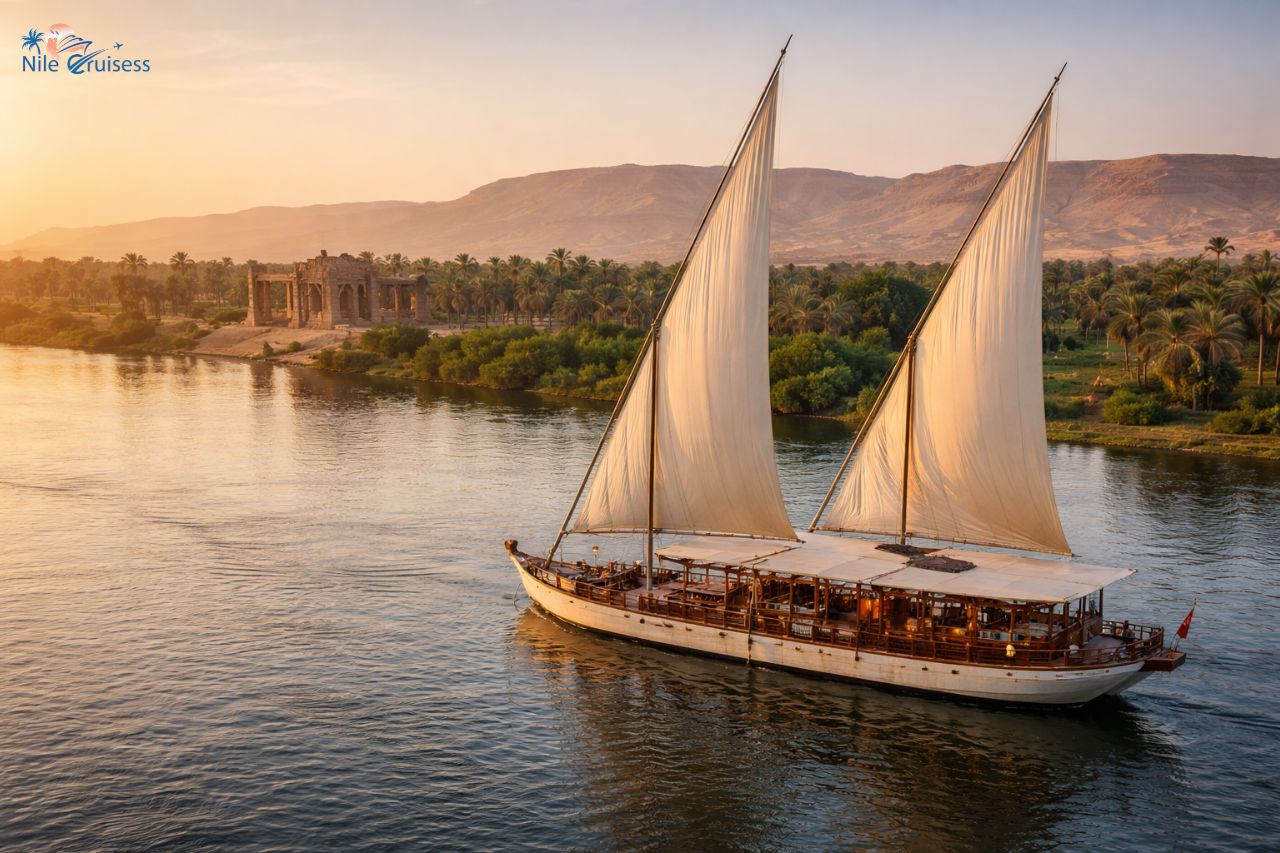
Beyond the Crowds: How Eco-Luxury Dahabiya Nile Cruises Are Redefining Responsible Travel in Egypt
Objective
- Explain why an eco-luxury Dahabiya Nile cruise offers a quieter and more responsible way to see Egypt.
- Show how slow sailing changes the travel experience.
- Explore the value of smaller boats, fewer crowds, and deeper cultural contact.
- Highlight how traditional travel on the Nile can feel both refined and thoughtful.
- Help readers understand why this style of journey fits modern responsible travel.
Key Takeaways
- A Dahabiya Nile cruise is smaller, slower, and quieter than a large cruise ship.
- Traditional sailing creates a more peaceful and personal view of the Nile.
- Smaller vessels can support a lower-impact style of travel, especially when they rely less on heavy engine use.
- Time in riverside villages can make the journey feel more human and less staged.
- Eco-luxury on the Nile is not just about comfort. It is about traveling with more care and attention.
Table Of Contents
- Beyond The Crowds On A Dahabiya Nile Cruise
- Why Eco-Luxury Dahabiya Nile Cruise Travel Feels Different
- The Quiet Power Of Traditional Sailing On The Nile
- A More Personal View Of Egypt’s Living River
- Responsible Travel in Egypt Through Slower Movement
- Cultural Depth Beyond Major Temple Stops
- Why Small-Scale Nile Travel Matters In 2026
- Final Thoughts
- FAQs
Beyond The Crowds: How Eco-Luxury Dahabiya Nile Cruises Are Redefining Responsible Travel In Egypt
There is a different side of the Nile that many travelers never get to see. It is calmer. It moves at the pace of wind and water. It leaves more space for silence, reflection, and real contact with local life. That is part of what makes an eco-luxury Dahabiya Nile cruise stand out.
Large cruise ships still shape the image many people have of Nile travel. They move in groups. They follow fixed rhythms. They bring comfort, but they often bring noise and crowds too. A Dahabiya Nile cruise offers another path. It feels smaller, softer, and closer to the river itself. Egypt’s official tourism platform describes dahabeyas as two-masted wooden sailboats that are quieter, slower, and more tranquil than typical cruise ships because they are much smaller and sail with minimal engine dependence.
That difference matters more now. Travelers are paying closer attention to how they move through a place. They want meaning, not just motion. They want comfort, but not at the cost of connection. In that space, the idea of an eco-luxury Dahabiya Nile cruise has become more important. Nile Cruises is one of the travel names that appears in this wider conversation about slower and more thoughtful journeys on the river.
Why Eco-Luxury Dahabiya Nile Cruise Travel Feels Different
A dahabiya does not try to overpower the Nile. It works with it. The sails catch the breeze. The boat glides instead of pushing forward with the same force as a large vessel. That simple change affects everything.
The sound changes first. There is less engine noise. There is more water, wind, and birdsong. The mood changes next. Without the rush of a crowded floating hotel, the river feels alive in a different way. Travelers notice farmers on the banks, children waving from shore, and the shape of palms moving in evening light.
That is where eco-luxury begins. It is not only about soft sheets, polished wood, or attentive service. It is also about a lower-impact rhythm. A smaller boat takes up less space, carries fewer people, and can create a more careful relationship with the landscape. Even when a dahabiya uses support power at times, its identity remains tied to slower sailing and a lighter feeling on the river. Egypt’s tourism materials present dahabeyas as an intimate option for traveling between Luxor and Aswan, with the freedom to stop in less-traveled places along the way.
The Quiet Power Of Traditional Sailing On The Nile
The Nile is not only a route between famous monuments. It is one of the oldest living corridors in the world. A journey by traditional sail feels closer to that long history.
A Dahabiya Nile cruise carries some of that memory. These boats reflect an older style of travel on the river, one linked to patience rather than speed. That does not make the journey feel outdated. It makes it feel grounded. The boat becomes part of the setting instead of standing apart from it.
This matters in a place like Upper Egypt, where the landscape still holds layers of ancient history and daily life side by side. UNESCO describes Ancient Thebes, on the banks of the Nile near Luxor, as one of the great centers of Egyptian civilization, with Karnak, Luxor, and the great necropolises spread across the east and west banks. On a smaller sailing journey, these sites do not feel like isolated attractions. They feel connected by the river that shaped them.
A More Personal View Of Egypt’s Living River
One of the strongest parts of an eco-luxury Dahabiya Nile cruise is intimacy. Not romance in the narrow sense, but human scale. There are fewer cabins. Fewer shared spaces. Fewer people are moving at once. Service becomes more personal because the setting allows it.
That smaller scale often changes what travelers remember.
They may remember:
- Morning tea on deck while the riverbank wakes up
- A quiet stop near a small village
- Time to watch fishermen at work
- The sight of fields turning gold late in the day
Those moments sound simple, but they matter. They remind travelers that Egypt is not only a collection of grand ruins. It is also a river country where daily life still unfolds along the banks.
Responsible Travel in Egypt Through Slower Movement
Responsible travel is often reduced to slogans. But on the Nile, it can be understood in a practical way. Travel has a different effect when it moves slowly, stays smaller, and pays attention to the place.
A responsible travel experience in Egypt should do more than reduce noise. It should encourage respect. It should allow travelers to see local communities as real places, not just background scenes. It should support a style of travel where observation comes before consumption.
UNESCO’s broader work on cultural heritage argues that culture is a vital resource for identity, community, and sustainable development. That idea fits the Nile well. The river is not only scenic. It holds living traditions, working villages, farming patterns, crafts, and social routines that deserve care.
A smaller Dahabiya Nile cruise does not solve every challenge linked to tourism. But it can support a gentler kind of presence. That alone makes it meaningful.
Cultural Depth Beyond Major Temple Stops
The finest Nile journeys are not built only around famous names. Luxor and Aswan matter deeply, of course. But the quieter hours in between can shape the deepest memories.
That is where the cultural side of an eco-luxury Dahabiya Nile cruise becomes clear. Travelers may pass date palms, village docks, mud-brick homes, and riverside life that feels untouched by hurry. These scenes are not staged museum pieces. They are part of the present.
This kind of travel helps people understand that the Nile is both ancient and current. It is a place of heritage, but also of work, family, agriculture, and movement. A refined journey does not need to pull away from that truth. It can sit beside it with humility.
In the middle of that experience, Nile Cruises can be understood not just as a travel label, but as part of a wider interest in calmer Nile journeys that place cultural immersion beside comfort.
Why Small-Scale Nile Travel Matters In 2026
Travelers today are asking better questions. They want to know how to move through famous places without adding to the pressure those places already face. Egypt remains one of the world’s great travel destinations, and the Nile remains central to that appeal. That is exactly why scale matters.
Smaller journeys can offer:
- Less crowd pressure on the travel experience
- More direct attention from the crew and guides
- More room for silence and reflection
- Better chances for real local contact
- A stronger feeling of the Nile as a living landscape
In this sense, eco-luxury is not a trend word. It is a useful idea. It points to a form of comfort that does not depend on excess. It values restraint, care, and depth.
Final Thoughts
An eco-luxury Dahabiya Nile cruise is redefining responsible travel in Egypt because it offers something many travelers now value more than spectacle. It offers closeness. Closeness to the river, to silence, to local life, and to the long cultural story of the Nile. A Dahabiya Nile cruise does not rush past Egypt. It lets Egypt unfold slowly.
That may be the real luxury now. Not doing more, but seeing more because the journey asks less of the landscape and more of the traveler’s attention. Nile Cruises belongs naturally in this conversation because the future of Nile travel may depend on experiences that are smaller in scale and deeper in feeling.
Choose the kind of Nile journey that leaves more room for the river, for culture, and for thoughtful travel.
FAQs
What Is A Dahabiya Nile Cruise?
A Dahabiya Nile cruise is a traditional style of Nile journey on a small wooden sailboat, usually with two sails and far fewer passengers than a large cruise ship. Egypt’s official tourism site describes dahabeyas as smaller, quieter, and more tranquil than typical Nile cruise vessels.
Why Is An Eco-Luxury Dahabiya Nile Cruise Seen As More Responsible?
It is often seen as more responsible because it is smaller in scale, quieter in operation, and better suited to slow travel. This can help create a lower-impact and more thoughtful travel experience.
Are Dahabiya Cruises More Cultural Than Large Nile Cruises?
They can feel more cultural because the pace is slower and the setting is more intimate. Travelers often spend more time noticing village life, river landscapes, and the living side of the Nile beyond major monuments.
Does A Dahabiya Nile Cruise Still Visit Important Historic Sites?
Yes. Dahabiyas usually sail in the Luxor to Aswan region, where some of Egypt’s most important ancient sites are located, including the area of Ancient Thebes recognized by UNESCO.
Is Dahabiya Better For Travelers Who Want Quiet?
Usually, yes. Dahabiyas are known for a calmer atmosphere because they are smaller and traditionally rely more on sailing than constant engine-powered movement.
What Makes Responsible Travel in Egypt Meaningful On The Nile?
It becomes meaningful when travel respects both heritage and present-day life. That includes moving more slowly, paying attention to local communities, and treating the Nile as a living cultural landscape, not just a sightseeing route.